
Abstract
Introduction: Rapid fluctuations in estimated glomerular filtration rate (eGFR) during the early post-transplant period can complicate valganciclovir dosing, which requires adjustment according to renal function. This study aimed to evaluate the appropriateness of valganciclovir prophylaxis dosing based on eGFR in kidney transplant recipients and to examine its associations with cytomegalovirus (CMV) DNAemia, hematological parameters, and changes in kidney function.
Materials and Methods: This single-center retrospective study included 71 adult kidney transplant recipients who underwent transplantation between October 2023 and May 2025 and received valganciclovir prophylaxis for at least 3 months. Dose appropriateness was evaluated using Chronic Kidney Disease Epidemiology Collaboration-based eGFR values (mL/min/1.73 m2) automatically reported by the hospital laboratory, consistent with routine clinical practice at our center. Hematological parameters and eGFR values measured at prophylaxis initiation and completion were compared. CMV DNA polymerase chain reaction surveillance was conducted every 2 weeks during prophylaxis and monthly thereafter through 1 year after transplantation.
Results: The median patient age was 40 years [interquartile range (IQR), 32–52.5], and 63.4% were male. At prophylaxis initiation, 35 (49.3%) patients received an eGFR-appropriate valganciclovir dose, whereas 34/71 (47.9%) received a higher-than-recommended dose and 2/71 (2.8%) received a lower-than-recommended dose. By prophylaxis completion, the proportion receiving an appropriate dose had increased to 66/71 (93.0%); 5/71 (7.0%) continued to receive a higher-than-recommended dose, and none received a lower-than-recommended dose. Late-onset CMV DNAemia developed in 7 (9.9%) patients at a median of 6 months (IQR, 5–9) after transplantation. Among patients who initially received eGFR-inappropriate dosing and had complete paired data, white blood cell count and neutrophil counts decreased significantly, whereas lymphocyte counts and eGFR increased significantly during prophylaxis (all p < 0.001). At prophylaxis completion, however, hematological parameters did not differ significantly between patients receiving appropriate and inappropriate doses.
Conclusion: eGFR-inappropriate valganciclovir dosing was frequent at prophylaxis initiation but decreased substantially over the course of follow-up. Because eGFR can change dynamically during the early post-transplant period, valganciclovir dosing should be reassessed regularly to ensure continued dose appropriateness. Multidisciplinary monitoring and antiviral stewardship strategies may help maintain appropriate valganciclovir dosing throughout prophylaxis.
Keywords: Kidney transplantation, valganciclovir, cytomegalovirus, estimated glomerular filtration rate, drug dosage calculations
Introduction
Cytomegalovirus (CMV) infection remains one of the most common opportunistic infections affecting solid organ transplant (SOT) recipients. It can cause serious disease in transplant recipients and, through its immunomodulatory effects, adversely affect both short- and long-term graft function[,]. In particular, kidney transplant recipients who are CMV-seropositive and receive lymphocyte-depleting agents such as anti-thymocyte globulin (ATG) for induction therapy are at substantial risk of CMV DNAemia because latent CMV can be reactivated in the setting of profound ATG-induced immunosuppression[]. Therefore, CMV prevention is a major focus of care in this high-risk patient population.
Current guidelines recommend the early initiation of valganciclovir prophylaxis in high-risk kidney transplant recipients. This prophylactic strategy effectively reduces CMV DNAemia and CMV disease during periods of high risk and limits the indirect effects of CMV, including graft dysfunction, acute rejection, and other opportunistic infections[-]. However, prolonged antiviral exposure requires careful monitoring because of potential drug toxicity, particularly hematological adverse effects, as well as the risk of antiviral resistance[]. Thus, optimizing valganciclovir use is essential. Higher-than-recommended doses increase the risk of drug-related bone marrow suppression, whereas inadequate dosing may result in clinically significant CMV infection and the development of valganciclovir resistance[,,,].
Myelotoxicity is one of the major limitations of valganciclovir prophylaxis and may manifest as neutropenia, leukopenia, or anemia[]. Although myelotoxicity can also occur with other medications commonly used in SOT recipients, it has been reported significantly more frequently among patients receiving valganciclovir prophylaxis[]. These adverse effects may necessitate premature discontinuation of prophylaxis, potentially increasing the risk of late CMV infection, particularly among patients receiving higher drug doses and those with impaired kidney function[,]. Because valganciclovir is primarily eliminated by the kidneys, its dose must be adjusted according to renal function. However, maintaining appropriate dosing in kidney transplant recipients can be challenging because kidney function may change rapidly during the early post-transplant period.
Previous real-world studies have demonstrated that discordance between prescribed valganciclovir doses and renal function-based dosing recommendations is common after kidney transplantation. Rissling et al.[] reported frequent valganciclovir underdosing, particularly in the context of improving renal function. Hammer et al.[] found that fewer than half of weekly dose assessments were appropriate. More recent studies by Rigon et al.[] and Forsyth et al.[] further suggested that suboptimal valganciclovir dosing may be associated with CMV DNAemia and hematological toxicity. Collectively, these findings underscore the difficulty of maintaining appropriate valganciclovir dosing during the early post-transplant period, when renal function can change rapidly[-].
However, real-world data on longitudinal changes in valganciclovir dose appropriateness and their relationship with CMV DNAemia, hematological parameters, and renal function during prophylaxis remain limited. We hypothesized that valganciclovir prophylaxis dosing may frequently be discordant with estimated glomerular filtration rate (eGFR)-based dosing categories during the early period after kidney transplantation because of rapidly changing renal function. Therefore, this study aimed to evaluate the appropriateness of valganciclovir prophylaxis dosing based on routinely reported eGFR values in kidney transplant recipients and to assess its relationship with CMV DNAemia, hematological parameters, and changes in kidney function.
Materials and Methods
In this single-center retrospective study, adult patients who underwent kidney transplantation at the Ankara Etlik City Hospital Organ Transplant Center between October 2023 and May 2025 were evaluated. Patients included in the study had received valganciclovir for at least 3 months as post-transplant CMV prophylaxis and had a follow-up period of 1 year after transplantation. Patients with complete clinical and laboratory data from the initiation to the completion of prophylaxis were assessed. Patients younger than 18 years, those who underwent multiple organ transplantation, those with active CMV infection before prophylaxis initiation, and those with missing required data were excluded. The study was approved by the University of Health Sciences Türkiye, Ankara Etlik City Hospital Scientific Research Evaluation and Ethics Committee (decision number: AEŞH-BADEK2-2025-291; approval date: 22.07.2025). The study was conducted in accordance with the principles of the Declaration of Helsinki. Given the retrospective nature of the study and the use of anonymized patient data, the requirement for individual informed consent was waived by the ethics committee.
The reporting of this study followed the Strengthening the Reporting of Observational Studies in Epidemiology statement.
Demographic and clinical data were retrospectively obtained from the electronic patient record system. Data on age, gender, etiology of end-stage renal failure, type of transplant, CMV donor and recipient serologies, induction and maintenance immunosuppressive therapy, use of ATG and pulse steroids, concomitant bacterial or fungal infections, rejection episodes, and CMV DNAemia status were recorded. At our center, CMV prophylaxis is routinely administered to CMV-seropositive recipients and/or patients receiving lymphocyte-depleting induction therapy. In this study, CMV prophylaxis was initiated within the first 10 days after transplantation.
Valganciclovir prophylaxis and dose adjustments were planned through joint assessment by the nephrology and infectious diseases teams. Dose modifications were reviewed during outpatient visits based on the patients’ current kidney function. Kidney function tests were routinely performed during hospitalization and after discharge during outpatient visits, and the valganciclovir dose was adjusted accordingly when necessary. In routine clinical practice at our center, renal function for valganciclovir dose assessment is evaluated using the eGFR automatically reported by the hospital laboratory based on the Chronic Kidney Disease Epidemiology Collaboration (CKD-EPI) equation. Accordingly, in this retrospective real-world study, valganciclovir dose appropriateness was assessed using the recorded eGFR values (mL/min/1.73 m2). Although conventional valganciclovir renal dose-adjustment recommendations are based on creatinine clearance, the corresponding renal function thresholds were applied to the routinely reported eGFR values to classify the prescribed dose as appropriate, lower than recommended, or higher than recommended[] (Box).
Dose appropriateness was assessed at two predefined time points: at prophylaxis initiation and at prophylaxis completion, using the contemporaneous eGFR at each time point. Dose appropriateness between these two time points was not systematically assessed over time.
At our center, CMV DNA polymerase chain reaction (PCR) surveillance was routinely performed every 2 weeks during valganciclovir prophylaxis and monthly after prophylaxis completion until 1 year post-transplantation. Additional CMV DNA PCR testing was performed outside the scheduled surveillance when clinical signs or symptoms suggestive of CMV infection were present. CMV infection was defined as the detection of CMV replication regardless of symptoms, whereas CMV disease was defined as the presence of clinical findings related to CMV infection or end-organ involvement. CMV DNAemia was defined as the detection of viral DNA at any level by quantitative PCR[].
CMV DNA was quantified in plasma using a quantitative nucleic acid test on the cobas 8800 System with real-time PCR. The linear range of the assay was 34.5–10,000,000 IU/mL, with 1 IU/mL corresponding to 1.1 copies/mL.
CMV risk groups were classified based on the donor (D) and recipient (R) anti-CMV immunoglobulin G results:
• Low risk: D−/R−
• Moderate risk: D+/R+ or D−/R+
• High risk: D+/R−
All patients with detected CMV DNAemia received valganciclovir/ganciclovir treatment.
White blood cell (WBC) count, absolute neutrophil count, lymphocyte count, hemoglobin level, platelet count, and eGFR were evaluated at the start and end of prophylaxis.
The primary endpoint of the study was to assess whether the valganciclovir dose at prophylaxis initiation was appropriate according to the routinely reported CKD-EPI-based eGFR. Secondary endpoints included changes in dose appropriateness at the end of prophylaxis, development of late-onset CMV DNAemia, changes in hematological parameters, and changes in kidney function.
Statistical Analysis
Statistical analyses were performed using IBM SPSS Statistics for Windows (Version 26, IBM Corp., Armonk, NY, USA). The distribution of continuous variables was assessed using the Shapiro–Wilk test and by examining histograms. Non-normally distributed continuous variables were presented as medians and interquartile ranges (IQRs), whereas categorical variables were expressed as numbers and percentages. The Mann–Whitney U test was used to compare independent groups, and the chi-square test or Fisher’s exact test was used for comparisons of categorical variables. The Wilcoxon signed-rank test was used to compare paired measurements before and after prophylaxis. A two-sided p < 0.05 was considered statistically significant.
Results
Between October 2023 and May 2025, a total of 75 adult patients who underwent kidney transplantation were evaluated. One patient was excluded because they received valganciclovir prophylaxis for less than 3 months, another because they had less than 1 year of post-transplant follow-up, and two because of missing clinical or laboratory data. Thus, a total of 71 patients who met the inclusion criteria were included in the analysis.
The median age of the patients was 40 years (IQR, 32–52.5), and 45 (63.4%) were male. The most common cause of kidney failure was an unknown etiology, identified in 34 (47.9%) patients, followed by glomerulonephritis in 15 (21.1%) and diabetes mellitus in 8 (11.3%). Of the transplants, 58 (81.7%) were from living donors. Sixty-seven recipients (94.4%) were CMV IgG seropositive (R+), whereas 4 (5.6%) were seronegative (R−). The median duration of CMV prophylaxis was 3 months (IQR, 3–6). During follow-up, CMV DNAemia occurred in 7 (9.9%) patients, and rejection episodes developed in 13 (18.3%). Concomitant bacterial infections were observed in 38 (53.5%) patients and fungal infections in 5 (7.0%) ().
Table 1. Demographic, clinical, and CMV-related characteristics of kidney transplant recipients.
Variable | Value |
|---|---|
Age (years), median (IQR) | 40.0 (32.0–52.5) |
Sex, n (%) | |
Female | 26 (36.6) |
Male | 45 (63.4) |
White blood cell count (/µL) at prophylaxis initiation, median (IQR) | 10,150.0 (7,250.0–12,330.0) |
Neutrophil count (/µL) at prophylaxis initiation, median (IQR) | 9,280.0 (6,095.0–11,750.0) |
Lymphocyte count (/µL) at prophylaxis initiation, median (IQR) | 130.0 (75.0–370.0) |
Hemoglobin (g/dL) level at prophylaxis initiation, median (IQR) | 9.7 (8.3–10.5) |
Platelet count (/µL) at prophylaxis initiation, median (IQR) | 161,000 (138,500–196,000) |
White blood cell count (/µL) at prophylaxis completion, median (IQR) | 5,915.0 (4,770.0–8,540.0) |
Neutrophil count (/µL) at prophylaxis completion, median (IQR) | 3,770.0 (2,830.0–6,490.0) |
Lymphocyte count (/µL) at prophylaxis completion, median (IQR) | 1,260.0 (910.0–1,770.0) |
Hemoglobin (g/dL) level at prophylaxis completion, median (IQR) | 11.5 (9.8–12.6) |
Platelet count (/µL) at prophylaxis completion, median (IQR) | 260,000 (203,000–294,000) |
eGFR at prophylaxis initiation, median (IQR) | 20.0 (14.0–46.5) |
Patients receiving an appropriate valganciclovir dose according to eGFR, n (%) | 35 (49.3) |
eGFR at prophylaxis completion, median (IQR) | 54.5 (45.0–65.0) |
Patients receiving an appropriate valganciclovir dose according to eGFR at prophylaxis completion, n (%) | 66 (93.0) |
Indication for kidney transplantation, n (%) | |
Unknown etiology | 34 (47.9) |
Glomerulonephritis | 15 (21.1) |
Diabetes mellitus | 8 (11.3) |
Hypertension | 5 (7.0) |
Familial Mediterranean fever | 4 (5.6) |
Other | 5 (7.0) |
Living-donor kidney transplantation, n (%) | 58 (81.7) |
Kidney replacement therapy before transplantation, n (%) | |
Hemodialysis | 61 (85.9) |
Peritoneal dialysis | 10 (14.1) |
Duration of chronic kidney disease (years), median (IQR) | 3.0 (2.0–7.5) |
Recipient CMV IgG serostatus, n (%) | - |
Negative | 4 (5.6) |
Positive | 67 (94.4) |
Donor CMV IgG serostatus, n (%) | |
Negative | 0 (0.0) |
Positive | 57 (80.3) |
Not available | 14 (19.7) |
Recipient CMV risk | |
Moderate risk D+/R+ | 53 (74.6) |
High risk D+/R− | 4 (5.6) |
Donor serostatus unavailable | 14 (19.7) |
Duration of CMV prophylaxis after transplantation (months), median (IQR) | 3.0 (3.0–6.0) |
Patients with CMV DNAemia, n (%) | 7 (9.9) |
Acute rejection during CMV DNAemia, n (%) | 2 (28.6) |
ATG administration during CMV DNAemia, n (%) | 2 (28.6) |
Pulse steroid therapy during CMV DNAemia, n (%) | 2 (28.6) |
Acute rejection after transplantation, n (%) | 13 (18.3) |
ATG administration after transplantation, n (%) | 50 (70.4) |
Pulse steroid therapy after transplantation, n (%) | 26 (36.6) |
CMV risk classification was based on available donor and recipient serostatus; donor CMV serostatus was unavailable in 14 recipients. IQR, interquartile range; eGFR, estimated glomerular filtration rate; CMV, cytomegalovirus; IgG, immunoglobulin G; ATG, antithymocyte globulin; D, donor; R, recipient (D+/R+: donor positive/recipient positive; D+/R−: donor positive/recipient negative).
After prophylaxis, 7 (9.9%) patients developed late-onset CMV DNAemia. The median time to CMV DNAemia was 6 months after transplantation (IQR, 5–9 months). The median peak CMV DNA level was 1200 IU/mL (IQR, 652–9380 IU/mL). Among patients with CMV DNAemia, 2 (28.6%) had concurrent rejection episodes, 2 (28.6%) received ATG therapy, and 2 (28.6%) were treated with pulse steroids. Four (57.1%) patients with CMV DNAemia were receiving an eGFR-appropriate dose, whereas 3 (42.9%) were receiving a higher-than-recommended dose of valganciclovir. No CMV DNAemia was observed among patients receiving a lower-than-recommended dose based on eGFR ().
At prophylaxis initiation, 35 (49.3%) patients received an appropriate valganciclovir dose according to eGFR, whereas 36 (50.7%) had inappropriate dosing; 34/71 (47.9%) received a higher-than-recommended dose, and 2/71 (2.8%) received a lower-than-recommended dose. By prophylaxis completion, 66/71 (93.0%) patients received an appropriate dose, 5/71 (7.0%) received a higher-than-recommended dose, and none received a lower-than-recommended dose. This increase in dose appropriateness reflects assessment against the contemporaneous eGFR and does not necessarily indicate that valganciclovir dose modifications were made in all patients whose classification changed. Individual dose modifications and their specific reasons were not systematically evaluated in this study (). Patients were grouped according to valganciclovir dose appropriateness at prophylaxis initiation, and laboratory parameters measured at prophylaxis completion were compared between these baseline-defined groups. At baseline, patients receiving inappropriate eGFR-based dosing had significantly lower lymphocyte counts (95 [55–160] vs. 240 [110–945]/mm3, p = 0.002), lower platelet counts (154,500 [133,500–176,000] vs. 184,000 [144,500–240,500]/mm3, p = 0.030), and substantially lower eGFR (14 [10–18] vs. 48 [30–57] mL/min/1.73 m2, p < 0.001) than those receiving appropriate dosing. By the end of prophylaxis, none of the between-group differences were statistically significant, including eGFR (49 [40–63] vs. 58 [49–70] mL/min/1.73 m2, p = 0.056). WBC, neutrophil, and hemoglobin values did not differ significantly between the two groups at either time point (all p > 0.05) (). Among the 35 patients with eGFR-inappropriate valganciclovir dosing at prophylaxis initiation and complete paired data, all four parameters showed statistically significant changes from prophylaxis initiation to completion. WBC and neutrophil counts decreased significantly (median changes, −4830/mm3 [−47.2%] and −6310/mm3 [−63.9%], respectively; both p < 0.001), whereas lymphocyte counts and eGFR increased significantly (+1070/mm3 [+1188.9%] and +35 mL/min/1.73 m2 [+250%], respectively; both p < 0.001) (; ; ).
Table 2. Laboratory parameters at the initiation and completion of valganciclovir prophylaxis according to baseline eGFR-based dose appropriateness.
Variables | Appropriate dose at baseline eGFR (n = 35) | Inappropriate dose at baseline eGFR (n = 36) | p value |
|---|---|---|---|
At prophylaxis initiation | |||
WBC (/mm3) | 8,990 (6,925–12,115) | 10,525 (7,800–12,330) | 0.280 |
Neutrophil (/mm3) | 7,360 (5,575–11,210) | 9,890 (6,830–12,025) | 0.171 |
Lymphocyte (/mm3) | 240 (110–945) | 95 (55–160) | 0.002 |
Hemoglobin (g/dL) | 9.5 (8.0–10.4) | 9.8 (8.9–10.6) | 0.337 |
Platelet (/mm3) | 184,000 (144,500–240,500) | 154,500 (133,500–176,000) | 0.030 |
eGFR (mL/min/1.73 m2) | 48 (30–57) | 14 (10–18) | < 0.001 |
At prophylaxis completion | |||
WBC (/mm3) | 6,200 (4,800–9,025) | 5,410 (4,780–8,400) | 0.363 |
Neutrophil (/mm3) | 4,140 (3,190–6,630) | 3,570 (2,595–6,125) | 0.280 |
Lymphocyte (/mm3) | 1,330 (940–1,735) | 1,160 (785–1,650) | 0.353 |
Hemoglobin (g/dL) | 11.6 (10.3–12.6) | 11.2 (9.4–12.6) | 0.477 |
Platelet (/mm3) | 265,000 (211,500–312,500) | 240,000 (190,500–286,000) | 0.335 |
eGFR (mL/min/1.73 m2) | 58 (49–70) | 49 (40–63) | 0.056 |
Data are presented as median (interquartile range, IQR). Group comparisons were performed using the Mann–Whitney U test. A p-value < 0.05 was considered statistically significant. eGFR, estimated glomerular filtration rate; IQR, interquartile range; WBC, white blood cell count.
Table 3. Within-group changes in laboratory parameters from valganciclovir prophylaxis initiation to completion among patients receiving eGFR-inappropriate dosing (n = 35 with complete paired data).
Variable | At initiation | At completion | Δ Median | Δ % | p value |
WBC (/mm3) | 10,525 (7,995–12,320) | 5,410 (4,780–8,400) | −4,830 | −47.2% | <0.001 |
Neutrophil (/mm3) | 9,890 (6,875–12,018) | 3,570 (2,595–6,125) | −6,310 | −63.9% | <0.001 |
Lymphocyte (/mm3) | 95 (58–160) | 1,160 (785–1,650) | +1,070 | +1,188.9% | <0.001 |
eGFR (mL/min/1.73 m2) | 14 (10–17) | 49 (40–63) | +35 | +250.0% | <0.001 |
Data are presented as median (interquartile range, IQR). Paired comparisons were performed using the Wilcoxon signed-rank test. One patient who died before completing prophylaxis was excluded from the paired analysis. A p value < 0.05 was considered statistically significant. eGFR, estimated glomerular filtration rate; IQR, interquartile range; WBC, white blood cell count; Δ, change between time points.
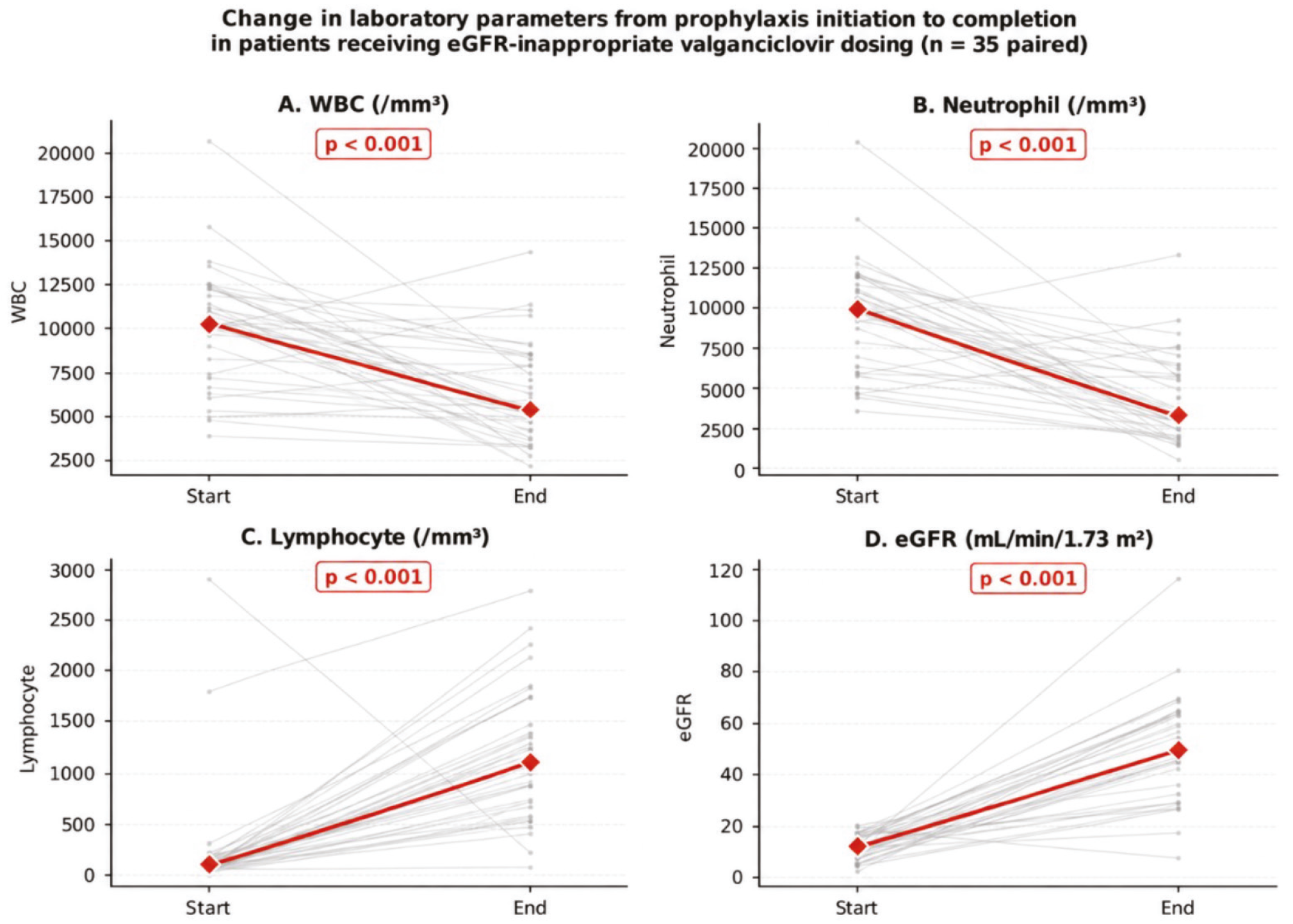
Individual patient trajectories (gray lines) and group medians (red diamonds) for WBC, neutrophil, and lymphocyte counts and eGFR from prophylaxis initiation (Start) to completion (End) in the 35 patients with eGFR-inappropriate valganciclovir dosing at prophylaxis initiation and complete paired data. The interval between prophylaxis initiation and completion varied according to the duration of valganciclovir prophylaxis. WBC and neutrophil counts decreased significantly, whereas lymphocyte counts and eGFR increased significantly over the prophylaxis period (all p < 0.001, Wilcoxon signed-rank test).
WBC, white blood cell count; eGFR, estimated glomerular filtration rate.
Box. Valganciclovir prophylaxis dosing according to eGFR categories used for dose assessment in the study.
eGFR used for dose assessment (mL/min/1.73 m2) | Valganciclovir prophylaxis dose |
≥60 | 900 mg once daily |
40–59 | 450 mg once daily |
25–39 | 450 mg every 2 days |
25–39 | 450 mg twice weekly |
eGFR, estimated glomerular filtration rate.
Discussion
Valganciclovir prophylaxis is the standard approach recommended by current guidelines for preventing CMV infection, particularly in kidney transplant recipients who receive ATG and are CMV-seropositive[2]. However, the need for dose adjustment according to renal function, combined with rapid changes in kidney function during the early post-transplant period, makes maintaining appropriate dosing challenging in clinical practice. In our study, real-world valganciclovir prophylaxis data from kidney transplant recipients were evaluated, and although approximately half of the patients received an inappropriate dose based on eGFR at prophylaxis initiation, the incidence of CMV DNAemia was low, and most patients achieved appropriate dosing during follow-up. Additionally, among patients who initially received an eGFR-inappropriate dose, significant changes in hematological parameters and an increase in eGFR were observed during follow-up.
In our study, the median time to CMV DNAemia among patients who developed CMV DNAemia was 6 months after transplantation. In a study evaluating the frequency of CMV infection following valganciclovir prophylaxis in 481 high-risk CMV D+/R− kidney transplant recipients, CMV infection developed in 38% of patients. The infection occurred at a median of 264 days after transplantation and 84 days after the end of prophylaxis[14]. The occurrence of CMV DNAemia within approximately 3 months after prophylaxis in our study highlights the importance of close monitoring after prophylaxis completion.
In a study evaluating weekly laboratory data from kidney transplant recipients receiving valganciclovir prophylaxis at two centers, more than half of the dose assessments were not concordant with renal function-based dosing recommendations. Of 1,032 weekly dose assessments based on weekly kidney function tests, 460 (44.6%) involved an appropriate valganciclovir dose, whereas 234 (22.7%) involved underdosing (below the recommended dose) and 338 (32.8%) involved overdosing (above the recommended dose)[11]. A recent retrospective study showed that kidney transplant recipients received valganciclovir doses outside the recommended range on approximately half (49%) of treatment days during prophylaxis[15]. Similarly, in our study, approximately half of the patients (50.7%) were initially found to have inappropriate dosing based on eGFR. Although conventional valganciclovir renal dose-adjustment recommendations are based on creatinine clearance, dose appropriateness in our study was evaluated using the eGFR routinely used for dose assessment at our center, thereby reflecting real-world clinical practice.
These findings suggest that the method used to assess kidney function during the early post-transplant period, together with rapid changes in renal function, may influence valganciclovir dose classification and subsequent dose adjustments.
The optimal dosing strategy for valganciclovir prophylaxis has not yet been fully established. Although some studies suggest that low-dose prophylaxis may provide efficacy comparable to that of standard doses in selected patient populations while reducing myelosuppressive adverse effects[16-18], higher-than-recommended doses are particularly associated with hematological toxicity resulting from bone marrow suppression[2,11,19]. In another recently published retrospective study, kidney transplant recipients received the optimal dose during only 51% of the follow-up period while receiving valganciclovir prophylaxis; doses below the recommended level were associated with breakthrough CMV DNAemia, whereas higher-than-recommended doses were associated with the development of neutropenia[13]. Taken together, these findings suggest that variability in renal function makes it challenging to maintain an appropriate valganciclovir dose and that dose inadequacy may affect clinical outcomes.
Based on available evidence, current guidelines recommend adjusting the valganciclovir dose according to kidney function and reassessing the dose as renal function changes[2]. Therefore, the recommended approach is to adjust the dose according to kidney function and regularly reassess treatment in response to changes in renal function[1,2,7]. Nevertheless, real-world data continue to show that dose mismatches based on eGFR are common among kidney transplant recipients[11,19].
In our study, among patients who initially received an eGFR-inappropriate, predominantly higher-than-recommended dose of valganciclovir, WBC and neutrophil counts decreased significantly during prophylaxis, whereas lymphocyte counts and eGFR increased significantly. These findings represent longitudinal changes observed during the prophylaxis period and should not be interpreted as direct effects of valganciclovir dosing. In a study evaluating more than 1,500 patients who underwent transplantation between 2010 and 2016 at two major transplant centers, patients who received valganciclovir prophylaxis were compared with those who did not. The valganciclovir prophylaxis group had significantly higher rates of myelosuppression-related adverse effects, including leukopenia, severe leukopenia, and thrombocytopenia[5]. In a study evaluating dosing differences in pediatric patients, it was emphasized that variations in dosing strategies may not always affect CMV outcomes but may have significant effects on hematological toxicity[19]. However, the hematological changes observed in our cohort cannot be attributed solely to valganciclovir, as concomitant myelosuppressive and immunosuppressive therapies may also have contributed. The decreases in leukocyte and neutrophil counts observed during prophylaxis are consistent with the known myelosuppressive effects of valganciclovir. However, the absence of significant differences in hematological parameters between the appropriate- and inappropriate-dose groups at prophylaxis completion suggests that these changes may not be attributable solely to valganciclovir dose, but may also have been influenced by concomitant immunosuppressive treatments and clinical changes during the early post-transplant period. Similarly, in a real-world, two-center study based on weekly dose assessments by Hammer et al.[11], no strong correlation was found between valganciclovir overdose and leukopenia or neutropenia. The authors proposed that the observed hematological changes might reflect the cumulative and time-dependent myelosuppressive effects of agents such as valganciclovir, mycophenolate mofetil, and thymoglobulin[11]. Given that 70.4% of our patients received ATG induction therapy and that other potentially myelosuppressive treatments, including mycophenolate mofetil and trimethoprim-sulfamethoxazole, are commonly used during the early post-transplant period, the hematological changes observed in our study are likely multifactorial. In addition, the increases in lymphocyte count and eGFR may partly reflect expected hematological and renal recovery during the early post-transplant period rather than the effects of valganciclovir dose appropriateness.
Study Limitations
Our study has some limitations. First, because of its retrospective and single-center design, it does not allow causal relationships to be established, and the generalizability of the results is limited. Second, the relatively small number of patients, particularly the small number who developed CMV DNAemia, may have reduced the statistical power of some analyses. Additionally, when evaluating hematological toxicity, the potential contributions of ATG, mycophenolate mofetil, trimethoprim-sulfamethoxazole, and other concomitant immunosuppressive treatments could not be analyzed separately. Similarly, the observed increase in eGFR may partly reflect the expected recovery of renal function during the early post-transplant period and cannot be attributed to valganciclovir dose adjustment. Another limitation is that valganciclovir dose appropriateness was assessed using the CKD-EPI-based eGFR routinely reported by our hospital laboratory, whereas conventional valganciclovir renal dose-adjustment recommendations are based on creatinine clearance. Because eGFR and creatinine clearance are not interchangeable, the use of eGFR may have resulted in different dose-appropriateness classifications in some patients. Dose appropriateness was assessed at two predefined time points, prophylaxis initiation and completion, and dose appropriateness during the intervening prophylaxis period was not analyzed in a time-dependent manner. Predefined clinical thresholds for cytopenias were not used; therefore, hematological findings were evaluated as longitudinal changes in laboratory parameters rather than as predefined toxicity events. Finally, because plasma levels of valganciclovir or ganciclovir were not measured, the relationship between dosing and actual drug exposure could not be evaluated.
Conclusion
The substantial increase in valganciclovir dose concordance from prophylaxis initiation to completion highlights the dynamic nature of dosing during the early post-transplant period. This improvement may reflect several factors, including stabilization of kidney function over time and ongoing clinical reassessment, and cannot be attributed solely to multidisciplinary follow-up. These findings indicate that valganciclovir dosing during the early period after kidney transplantation is not a one-time decision but rather a dynamic process that requires regular reassessment as kidney function changes. Although the effects of multidisciplinary follow-up or antiviral stewardship were not directly evaluated in our study, such strategies may support appropriate valganciclovir dosing in clinical practice. Our study adds real-world data by evaluating valganciclovir dose appropriateness based on eGFR together with longitudinal hematological changes. Larger, multicenter, prospective studies are needed to further clarify the clinical impact of optimal dosing strategies and structured monitoring approaches.
Ethics
Ethics Committee Approval: The study was approved by the University of Health Sciences Türkiye, Ankara Etlik City Hospital Scientific Research Evaluation and Ethics Committee (decision number: AEŞH-BADEK2-2025-291; approval date: 22.07.2025).
Informed Consent: Given the retrospective nature of the study and the use of anonymized patient data, the requirement for individual informed consent was waived by the ethics committee.
Footnotes
Authorship Contributions
Surgical and Medical Practices: G.D., Concept: G.K., E.I.S., G.D., E.O., Design: G.K., E.O., F.A.Y., P.B.Ü., Data Collection or Processing: P.B.Ü., Analysis or Interpretation: F.A.Y., Literature Search: G.K., E.I.S., E.O., Writing: G.K.
Conflict of Interest
No conflict of interest was declared by the authors.
Financial Disclosure
The authors declare that this study received no financial support.
References
Razonable RR, Humar A. Cytomegalovirus in solid organ transplant recipients-Guidelines of the American Society of Transplantation Infectious Diseases Community of Practice. Clin Transplant. 2019;33:e13512.
Kotton CN, Kumar D, Manuel O, Chou S, Hayden RT, Danziger-Isakov L, Asberg A, Tedesco-Silva H, Humar A; Transplantation Society International CMV Consensus Group. The Fourth International Consensus Guidelines on the management of cytomegalovirus in solid organ transplantation. Transplantation. 2025;109:1066-10.
Kumar L, Murray-Krezan C, Singh N, Brennan DC, Rakita RM, Dasgupta S, Fisher CE, Limaye AP. A systematic review and meta-analysis of optimized CMV preemptive therapy and antiviral prophylaxis for CMV disease prevention in CMV high-risk (D+R-) kidney transplant recipients. Transplant Direct. 2023;9:e1514.
Lee JH, Lee H, Lee SW, Hwang SD, Song JH. Efficacy and safety according to the dose of valganciclovir for cytomegalovirus prophylaxis in transplantation: network meta-analysis using recent data. Transplant Proc. 2021;53:1945-50.
Lahoud C, Franceschi AE, Reyes F, Moshovitis DG, Achkar A, Chakraborty A, Balusu M, Safiia J, Nussbaum EZ, Letourneau AR. Toxicities and clinical consequences of valganciclovir prophylaxis in solid organ transplant recipients. Open Forum Infect Dis. 2023;10:ofad500.
Belga S, Hernandez C, Kabbani D, Cervera C. Incidence of valganciclovir-related leukopenia and neutropenia in solid organ transplant recipients at high risk of cytomegalovirus disease. Transpl Infect Dis. 2024;26:e14227.
Vernooij RW, Michael M, Ladhani M, Webster AC, Strippoli GF, Craig JC, Hodson EM. Antiviral medications for preventing cytomegalovirus disease in solid organ transplant recipients. Cochrane Database Syst Rev. 2024;5:CD003774.
Matsumoto K, Shigemi A, Ikawa K, Kanazawa N, Fujisaki Y, Morikawa N, Takeda Y. Risk factors for ganciclovir-induced thrombocytopenia and leukopenia. Biol Pharm Bull. 2015;38:235-8.
Gift T, Palafox J, Jones K, Imburgia T, Astor T. CMV viremia after discontinuation of valganciclovir prophylaxis in lung transplant recipients. J Heart Lung Transplant. 2020;39:S485.
Rissling O, Naik M, Brakemeier S, Schmidt D, Staeck O, Hohberger A, Neumayer HH, Budde K. High frequency of valganciclovir underdosing for cytomegalovirus prophylaxis after renal transplantation. Clin Kidney J. 2018;11:564-73.
Hammer N, Hoessly L, Haidar F, Hirzel C, de Seigneux S, van Delden C, Vogt B, Sidler D, Neofytos D. Pitfalls in valganciclovir prophylaxis dose adjustment based on renal function in kidney transplant recipients. Transpl Int. 2024;37:12712.
Rigon PA, Solignac J, Zandotti C, Gully M, Brunet P, Resseguier N, Legris T, Moal V. Valganciclovir underdosing is associated with cytomegalovirus DNAemia during universal prophylaxis: a real-life case control retrospective study. J Med Virol. 2025;97:e70666.
Forsyth J, Randall D, Thuraisingham R. Accuracy of valganciclovir dosing following kidney transplantation and its impact on clinical outcomes. Front Nephrol. 2026;6:1781576.
Räihä J, Ortiz F, Mannonen L, Loginov R, Lempinen M, Lautenschlager I, Helanterä I. The burden of cytomegalovirus infection remains high in high-risk kidney transplant recipients despite six-month valganciclovir prophylaxis. Transpl Infect Dis. 2021;23:e13577.
Diehl K, Anderson-Haag T, Spenningsby A. Evaluation of discrepancies in valganciclovir dosing based on creatinine clearance and estimated glomerular filtration rate for cytomegalovirus prevention in kidney transplant patients. Am J Transplant. 2026;26:S510.
Shi Y, Lerner AH, Rogers R, Vieira K, Merhi B, Mecadon K, Osband AJ, Bayliss G, Gohh R, Morrissey P, Farmakiotis D. Low-dose valganciclovir prophylaxis is safe and cost-saving in CMV-seropositive kidney transplant recipients. Prog Transplant. 2021;31:368-76.
Gabardi S, Asipenko N, Fleming J, Lor K, McDevitt-Potter L, Mohammed A, Rogers C, Tichy EM, Weng R, Lee RA. Evaluation of Low- versus high-dose valganciclovir for prevention of cytomegalovirus disease in high-risk renal transplant recipients. Transplantation. 2015;99:1499-505.
Heldenbrand S, Li C, Cross RP, DePiero KA, Dick TB, Ferguson K, Kim M, Newkirk E, Park JM, Sudaria-Kerr J, Tichy EM, Ueda KR, Weng R, Wisniewski J, Gabardi S. Multicenter evaluation of efficacy and safety of low-dose versus high-dose valganciclovir for prevention of cytomegalovirus disease in donor and recipient positive (D+/R+) renal transplant recipients. Transpl Infect Dis. 2016;18:904-12.
Demirhan S, Munoz FM, Valencia Deray KG, Bocchini CE, Danziger-Isakov L, Blum S, Sharma TS, Sherman G, Boguniewicz J, Bacon S, Ardura MI, Maron GM, Ferrolino J, Foca M, Herold BC. Body surface area compared to body weight dosing of valganciclovir is associated with increased toxicity in pediatric solid organ transplantation recipients. Am J Transplant. 2023;23:1961-71.